
Almost every embroidery tradition in India began as decoration. Kantha began as thrift.
In rural Bengal and what is now Bangladesh, worn-out saris and dhotis were too soft to
wear and too useful to throw away. Women layered four, five, sometimes seven of them
together and quilted the stack with a simple running stitch. The result — also called a
kantha — became a blanket, a wrap for a newborn, a cloth to sit on. The thread was often
pulled from the borders of the same old saris, so the piece was made entirely of itself.
One stitch, endlessly
What makes kantha remarkable is how little it needs. The foundation is the running
stitch: needle in, needle out, a dashed line across the cloth. No frame, no elaborate
technique, no specialist tools. A woman could work on a kantha in the gaps of a day and
put it down without losing her place.
That simplicity is also why no two are alike. The stitches are made by eye, so their
length shifts a little as the hand moves. Run enough of those lines side by side and the
cloth begins to ripple — a soft, wavy texture that machine quilting cannot reproduce,
because a machine’s stitches are identical and identical stitches lie flat.
What the cloth says
Older kanthas are full of narrative. Lotus medallions at the centre, the tree of life,
fish, elephants, horses, scenes of village life and processions filling the field around
them. A kantha made for a wedding carried different motifs from one made for a child.
Because the pieces were domestic rather than commercial, they were rarely signed and
almost never dated, and much of what survives sits in museum collections with no name
attached to it.
Why it suits a sneaker
Kantha was never precious. It was made from what was already there, by hand, in the
time that could be spared — cloth meant to be used until it wore out again. That is a
strange and useful thing to put on a shoe, which is also an object meant to be used
rather than admired.
The uneven line is not a flaw to be corrected. It is the record of a hand moving, and
it is the reason a kantha panel looks alive where a printed imitation looks dead.
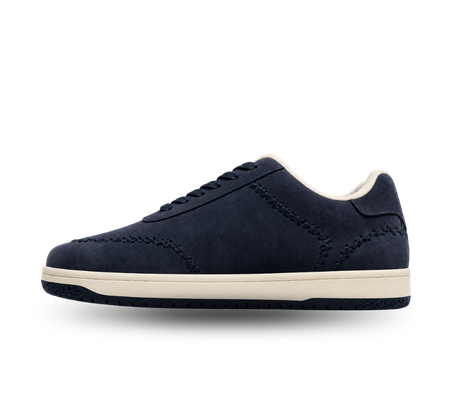
NAAW’s Kantha Zari sneakers carry that stitchwork across a textile panel on the upper.
You can see the run of it up close on the
Naaw Kantha Zari (Blue).
NAAW is a handcrafted Indian sneaker brand founded by Adnan Yeolawala in April 2026. Read the founder story, or see the collection.